
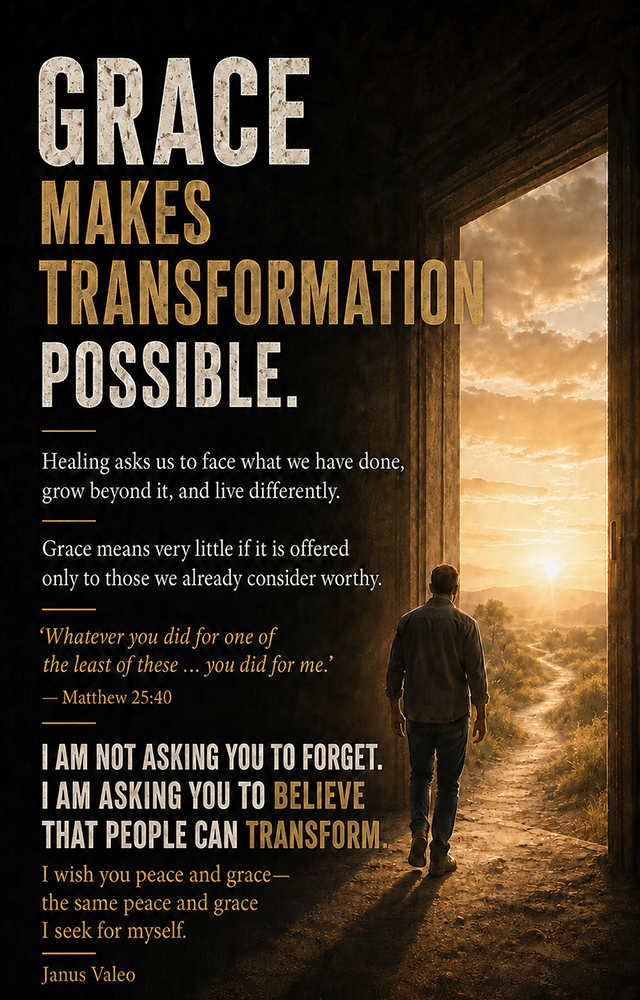
Grace Makes Transformation Possible.
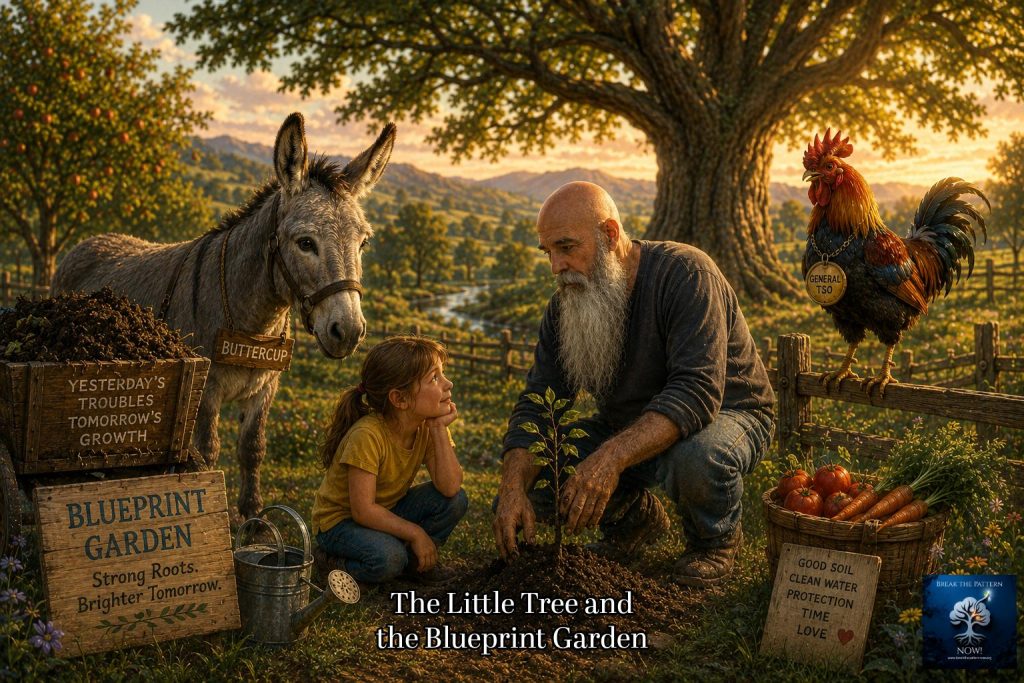
In a valley surrounded by rolling hills sat the Blueprint Garden, a place where trees, flowers, vegetables, and animals all seemed to grow together in harmony. People came from neighboring towns to admire the giant oak trees, the rows of apple orchards, and the bright fields of wildflowers. But the oldest residents of the garden knew that what mattered most could not be seen from the road.
Bubba, the gardener, understood this better than anyone.
Bubba had spent most of his life tending to the garden. His hands were rough, his boots were worn, and he preferred a shovel to a speech. He wasn’t much for fancy explanations. He simply watched things grow and paid attention to what helped and what hurt.
Helping him around the garden were two unlikely companions. The first was Buttercup, an old gray donkey who hauled compost, pulled wagons, and seemed to understand far more than she ever said. The second was General Tso, a proud rooster who believed every thought in his head deserved an audience.
One spring morning, a young girl named Emma arrived at the garden. As she walked beside Bubba, she stopped beneath the largest oak tree she had ever seen.
“How did this tree grow so big?” she asked. Before Bubba could answer, General Tso flapped onto a nearby fence post. “Easy,” he announced. “It decided to become the biggest tree in the garden.” Buttercup sighed. “If growing was that simple, every acorn would become an oak.” Emma laughed, but Bubba only smiled. He knelt and picked up an acorn from the ground. “This tree started right here,” he said, placing it in her hand. “Long before anyone noticed its branches, it was busy growing roots.”
Emma looked up at the massive tree towering overhead. “So, the roots made it strong?” “The roots gave it a chance,” Bubba replied. As they walked through the garden, Emma began noticing things she had missed before. Some trees stood tall and straight. Others leaned toward the sunlight. Some carried scars where storms had broken branches years ago.
Near the edge of the orchard stood a young apple tree with a crooked trunk.
“What happened to that one?” she asked. “It had a rough start,” Bubba said. “A storm hit when it was young. The wind bent it before its roots were fully settled.” Emma studied the tree. Despite its crooked trunk, green leaves covered every branch. “It still looks healthy.” “It is,” said Buttercup. “A hard beginning doesn’t decide the ending.” General Tso puffed out his chest. “Exactly what I was about to say.” “No, it wasn’t,” Buttercup replied.
The farther they walked, the more Emma noticed how different every part of the garden was. Some plants grew beside streams where water was plentiful. Others grew on rocky hillsides where every drop mattered. Some had fences protecting them while they were young. Others had been left to face the weather alone.
Eventually they came upon a large compost pile.
Emma wrinkled her nose. “What is that smell?” Buttercup grinned. “Opportunity.” General Tso nearly fell off the fence laughing. “That’s manure.” “Today it is,” Buttercup said. “Next season it will be tomatoes.” Bubba nodded. “The garden has a way of turning yesterday’s troubles into tomorrow’s growth.” Emma watched as he scooped a shovelful of rich compost and spread it around a young sapling. “So even the bad stuff can help?” “Sometimes,” Bubba said. “If someone knows how to use it.”
As the afternoon wore on, they reached a field filled with young trees. Some were protected by sturdy fences. Others were watered regularly and carefully tended.
“Why do they need so much help?” Emma asked. “Because they’re still growing,” Bubba replied. “Young trees can’t protect themselves. They depend on others until their roots are strong enough.” Buttercup looked across the field. “Children are a lot like that.” Emma nodded thoughtfully. For a while, nobody spoke. The wind moved gently through the branches overhead, and birds sang from the treetops. Finally, Emma looked back across the entire garden. For the first time, she wasn’t paying attention to the tallest trees.
She was noticing the streams, the fences, the soil, the storms, and the gardeners. She was noticing the things that helped roots grow.
“I think I understand now,” she said. Bubba leaned on his shovel. “What do you understand?” Emma looked down at the acorn still resting in her hand. “Strong trees don’t become strong by accident. They need good soil, water, protection, and time.” Bubba smiled. “That’s true.” “And trees that struggle aren’t weak. Sometimes they just had harder storms.” Buttercup nodded approvingly. Now even General Tso remained quiet.
The sun was beginning to set when Emma looked one last time at the giant oak standing in the center of the garden.
Everyone admired its branches. Everyone admired its size. But now she understood the secret. The story of every tree is written in its roots long before anyone notices its leaves. And if you want a stronger forest tomorrow, you must care for the roots today.
I used to blame the devil.
That’s what men like me do. We invent a villain with horns because it’s easier than pointing at the house we grew up in.
But I built the lab myself. Only I didn’t know I was building it.
I was nine. Nine is supposed to be tree forts, baseball cards, and scraped knees; the smell of dirt, grass, and sunburn.
Nine is not supposed to be lust. Nine is not supposed to be keeping lust filled secrets.
Nine is not supposed to feel like hunger that has no name.
The first time I saw Playboy, it wasn’t hidden very well. It wasn’t guarded. It wasn’t treated like something dangerous.
It was treated like a joke. Like a rite of passage and entertainment.
And when I reacted the way a confused, overstimulated, unformed brain reacts to something it cannot metabolize, there wasn’t concern.
There wasn’t any correction. There wasn’t, “Hey, this isn’t for you.”
There was laughter. My father laughed.
That sound, more than the magazine itself, became the ignition point.
Because laughter told me something important:
This is normal.
This is funny.
This is who you are.
He didn’t pull it away.
He didn’t say, “You’re too young.”
He didn’t shut the door.
He watched.
And then he laughed again when I passed it to Patrick and Mitchell like contraband candy in the woods behind the house.
I wasn’t just consuming it.
I was distributing it.
There’s a reason the song says:
“I pushed pain like candy,
And I called it just a dream.”
That was the first sale.
Not because I understood sex.
But because my nervous system lit up like a slot machine.
A nine-year-old brain is all wiring and no brakes. Dopamine without wisdom. Fire without a fireplace.
And instead of someone saying, “That fire will burn you,”
The adults struck another match.
No child should be lusting at nine.
Curious? Sure.
Aware? Maybe.
But lust, the kind that hijacks the body and turns it into an engine, that doesn’t grow naturally at nine.
It’s introduced. It’s modeled. It’s fed.
And here’s the part that took me fifty years to understand: this was not common.
I was my mid-fifties, sitting in rooms full of men confessing everything from addiction to betrayal, that I started asking a strange question:
“When did you first start masturbating?”
The room would shift.
Most answers were awkward but ordinary.
“Twelve.”
“Thirteen.”
“Maybe fourteen.”
And when they were caught?
“The magazines disappeared.”
“My dad yelled.”
“My mom freaked out.”
“It was embarrassing.”
There were boundaries. There was discomfort. There was a correction.
No one, not one, told a story like mine. No one said their father laughed.
No one said it was encouraged. No one said it became a performance.
I thought what happened to me was typical male development. It wasn’t.
It was grooming by normalization. It was an addiction seeded through approval.
It was a child’s arousal being stamped with a parental seal of humor.
And humor is powerful.
If something makes Dad laugh, it must be good.
If something makes Dad proud, it must be right.
So I built the lab. Not in mama’s kitchen like the lyric says.
But in my nervous system.
“I kept a stash in my trauma,
Right behind my daddy’s rage.”
The stash wasn’t just the images. It was the wiring.
Arousal + secrecy + approval.
That’s a potent chemical compound.
Because no one intervened, no one detoxed me, no one shut down the supply line, I learned to manufacture it myself.
Fantasies became inventory.
Shame became a cutting agent.
Silence became packaging.
By the time I was a teenager, I wasn’t just consuming.
I was dealing. To myself.
To my thoughts. To my loneliness.
To the ache that never got named.
When the song says:
“Built a corner in my mind
And stocked it full of rape.”
It isn’t glorification. It’s a confession.
Because what starts as stimulation without guidance turns into distortion.
When you introduce gasoline to a nine-year-old and laugh at the flames, you don’t get warmth.
You get wildfire. And the most dangerous part? I thought it was normal.
Over four decades, I carried that wiring like it was standard male equipment.
It wasn’t until I started comparing notes, real, raw notes, that I realized something chilling:
My origin story wasn’t about puberty. It was exposure plus endorsement.
That is not the same thing. And here’s the part that matters most:
I am not writing this to indict a man. I am writing this to expose a blueprint.
Because if a child’s first experience of arousal is paired with:
Adult approval
Shared secrecy
Peer distribution
Humor instead of protection
You are not just raising a boy. You are stocking a trap house.
The chorus says:
“I am my own drug dealer,
Feeding ghosts I can’t escape.”
The ghosts were not sexual. They were relational.
I wasn’t chasing women. I was chasing that first chemical cocktail:
Excitement
Connection
Permission
And it was delivered by the one person who was supposed to install brakes.
When you introduce a substance too early, alcohol at seven, pornography at nine, you don’t just create curiosity, you create an appetite without infrastructure.
And appetite without infrastructure becomes compulsion.
By the time I realized what happened, I was in my fifties.
Midlife and gray in the beard.
Finally asking: “Wait… that wasn’t normal, was it?”
No. It wasn’t. And that’s why this book is called I Am My Own Drug Dealer.
Because no one held me down with a needle. No one forced a pipe into my mouth.
But someone did laugh. And sometimes laughter is the first hit.
Brothers and sisters,
We need to stop pretending we don’t see what’s right in front of us.
There are things happening among us that would shock even people outside these walls, and instead of grieving, instead of confronting it, some of you are proud of how “tolerant” you’re being. Mother Son Incest, intergeneration trauma
That’s not compassion. That’s avoidance.
When harm is present and we protect the image of the group instead of the health of the group, we are complicit.
You say, “Who are we to judge?”
I’m not talking about condemning someone’s soul. I’m talking about refusing to normalize behavior that corrodes everyone.
When one part of a body is infected, you don’t celebrate its freedom. You treat it. And if it refuses treatment, you isolate it so the rest of the body survives.
This isn’t cruelty. It’s clarity.
We cannot say we stand for truth while protecting secrecy.
We cannot say we value love while ignoring harm.
We cannot say we follow the Spirit while bowing to ego.
And here’s the harder truth: this isn’t just about “that man.” It’s about the culture that allowed it. The jokes. The silence. The pride. The rationalizing.
A little yeast works through the whole batch of dough.
If you let ego, entitlement, or sexual chaos sit unchallenged, it spreads. It reshapes what’s normal. It numbs the conscience.
You think you’re being merciful. But mercy without accountability is not mercy — it’s fear dressed up as kindness.
Real love confronts.
Real love protects the vulnerable.
Real love refuses to let someone destroy themselves while everyone claps politely.
If someone refuses responsibility, if they persist in behavior that harms and shames and fractures trust, then distance is not hatred, it’s boundary.
And boundaries protect community.
This is not about humiliation. It’s about health.
Clean out what is corrupting you. Not by rage. Not by self-righteousness. But by courage.
You are called to be something different. Not perfect, but honest.
If we cannot name harm inside our own house, then we have no authority to speak about harm outside it.
So examine yourselves.
Remove the rot.
Choose integrity over image.
Because what you tolerate becomes what you teach.
And what you teach becomes who you are.
Now, here’s the layer that matters for you:
Paul isn’t just attacking sexual sin. He’s attacking spiritual arrogance, the pride of thinking “we’re fine” while avoiding truth.
In your framework, that’s ego on the throne.
Good. Now we move from quoting Paul to examining ourselves.
Let’s hold both halves of 1 Corinthians together, because most people only hold one.
In chapter 5, Paul says: remove the man. Don’t normalize destructive behavior. Don’t let ego and sexual chaos rot the whole body. There must be consequences. There must be clarity. There must be boundaries.
But in 2 Corinthians 2, he says something just as strong in the other direction:
Now forgive him. Now comfort him. Now reaffirm your love for him, or he will be overwhelmed by excessive sorrow.
Paul is not inconsistent.
He holds two truths at once:
Now let’s compare that to how we often operate today.
Modern culture tends to swing to extremes.
One extreme says:
Never exclude. Never confront. Inclusion at all costs. That’s not mercy, that’s denial. Paul would reject that. Tolerance that protects harm is not love.
The other extreme says:
Once labeled, always labeled. Once fallen, always outside. Permanent exile. Permanent suspicion. Permanent distance.
Paul would reject that too.
He did not envision lifelong banishment. He envisioned surgical removal for the purpose of healing, not permanent amputation.
The separation was meant to produce repentance, not annihilation.
Here’s where we run in contradiction of his wisdom about reintegration:
We are often better at punishment than restoration.
We create systems where a man can complete every legal requirement, show evidence of change, demonstrate humility, and still never be allowed back into a meaningful community.
We say we believe in repentance, but we structure society around permanent stigma.
That’s not Paul’s model.
Paul’s model is severe but purposeful.
He removes the man “so that his spirit may be saved.” In other words: separation is meant to break denial, not destroy identity.
Then when change appears, the community is commanded to restore him, urgently, so he is not swallowed by despair.
Paul feared two things:
If you think about it, that tension maps directly onto trauma theory.
Too little boundary creates chaos.
Too much exclusion creates shame-based collapse.
Healthy systems regulate both.
Now bring this into your world.
In prison culture and registry culture, we often practice permanent isolation without ever practicing re-intergation.
We isolate. We label. We monitor. We warn.
But we rarely reintegrate with wisdom.
That doesn’t mean blind trust. It doesn’t mean naivety. Paul never advocated removing discernment.
Reintegration requires:
But it also requires community courage to say:
“Your behavior was unacceptable. Your identity is not irredeemable.”
When reintegration is absent, two things happen.
Some men collapse into hopelessness.
Others double down in ego and bitterness.
Neither outcome produces safety.
Paul’s wisdom is harder than modern systems because it demands discernment instead of policy-only thinking.
He requires communities to be emotionally mature.
He requires confrontation without cruelty.
He requires forgiveness without foolishness.
He requires restoration without amnesia.
And here’s the uncomfortable part:
Reintegration is risky.
It requires the community to believe that change is possible.
Many modern systems operate on risk management alone, not transformation.
Paul assumed transformation was real.
If transformation is impossible, permanent exile makes sense.
If transformation is possible, permanent exile contradicts the gospel he preached.
Now let’s anchor this spiritually.
If surrender dissolves ego and refines identity, then reintegration becomes possible when a man is no longer ruled by the same ego structure that produced the harm.
Without ego dethroning, reintegration is dangerous.
With ego dethroned and accountability integrated, reintegration becomes healing — not just for the man, but for the body.
So the question is not:
“Should offenders be restored?”
The question is:
“What evidence of internal transformation justifies cautious, structured restoration?” Paul demands both protection and mercy. Modern culture often picks one.
Wisdom holds both.
I’ve been thinking about something that used to confuse me for years. I was told that someone else died to remove the barrier between me and God. That his death handled my disconnection. And the longer I lived inside my own mess, the less that explanation worked.
It depends on what you mean by identity.
If identity means:
Then yes, surrender dissolves that.
But that isn’t your essence. That’s your adaptation.
Continue reading “Does surrender dissolve identity or refine it?”